
We Turn Wood Into Great Things!
Join our Fall Sale - Get $100 off when you spend $1,000 or more with Code: FALL26

Questions about your custom bathroom vanities? Call or text 443-452-3922
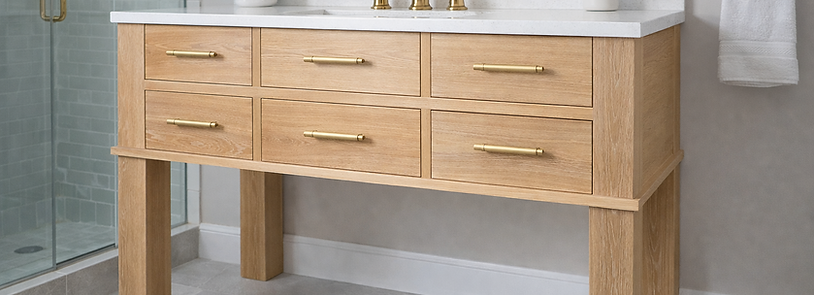
How Much Does a Custom Bathroom Vanity Cost?
If you're considering a custom bathroom vanity, one of your first questions is probably: How much should I expect to spend?
A handcrafted custom bathroom vanity will generally cost more than a mass-produced cabinet, but the comparison isn't quite apples to apples. A custom vanity can be built around your exact space, plumbing location, storage needs and preferred materials rather than requiring you to design your bathroom around a predetermined cabinet.
At Smith Custom Woodworks, we build made-to-order bathroom vanities in our Baltimore, Maryland workshop for homeowners, designers and contractors throughout Maryland, Washington, DC, Northern Virginia and beyond.
Our bathroom vanity bases currently start around $1,250, while larger premium hardwood and highly detailed designs can exceed $4,000.
What Does a Custom Bathroom Vanity Cost?
As a general starting point, expect a handcrafted custom or made-to-order vanity base to fall approximately within these ranges:
Vanity | Typical Range |
|---|---|
30-36" | $1,400–$2,200+ |
42–48" | $2,000–$3,200+ |
60" | $2,800–$4,500+ |
Highly customized | Quote |
These are planning ranges rather than fixed prices. The final cost depends on the design, wood species, dimensions, storage configuration, hardware, finish and degree of customization.
For example, a straightforward painted 30-inch vanity will normally cost considerably less than a 60-inch solid black walnut vanity with multiple drawers, doors, premium soft-close hardware and architectural detailing.
What Determines the Cost of a Custom Bathroom Vanity?
Several factors have a much greater impact on price than others. Understanding them can help you decide where to invest your remodeling budget.
1. Vanity Size
Not surprisingly, size matters.
A 60-inch vanity requires considerably more material than a 30-inch vanity. But material isn't the only difference.
Larger vanities usually require more:
-
Drawer boxes
-
Drawer slides
-
Doors and hinges
-
Interior partitions
-
Joinery
-
Sanding
-
Finishing
-
Assembly time
A larger cabinet may also require additional structural considerations because a long vanity must remain square, rigid and stable throughout its life.
For that reason, doubling the width doesn't necessarily produce a simple, proportional increase in price.
2. Wood Species
Your choice of wood can significantly affect the final price.
White Oak
White oak has become one of the most popular choices for modern bathroom cabinetry because of its distinctive grain, light natural color and ability to complement modern, transitional, Scandinavian and contemporary interiors.
It is an excellent choice when you want the vanity itself to provide warmth and texture without making the room feel dark.
Black Walnut
Black walnut is generally a more premium material.
Its rich brown color, natural variation and distinctive grain can turn a bathroom vanity into a focal point of the room.
Walnut is particularly well suited to Mid-Century Modern, contemporary and furniture-inspired bathroom designs.
Painted Hardwood
A painted vanity can provide another option for homeowners who want a classic white, gray or custom-color cabinet rather than visible natural wood grain.
Painted designs can sometimes cost less than premium walnut or white oak models, although design complexity and construction still have a major impact on the final price.
3. Drawers Cost More Than Open Cabinet Space
One of the less obvious factors affecting custom vanity pricing is the interior configuration.
A simple pair of doors concealing an open cabinet requires fewer components than a bank of functioning drawers.
Every drawer requires:
-
A drawer box
-
A finished drawer front
-
A pair of drawer slides
-
Additional joinery
-
Installation and alignment
-
Additional finishing
Premium undermount soft-close slides also cost considerably more than basic side-mount hardware.
At Smith Custom Woodworks, many of our vanity designs use Blum undermount soft-close drawer slides and soft-close hinges, along with maple drawer boxes.
The result is a more refined cabinet with smooth, quiet operation—but that quality is reflected in the cost.
4. Plumbing Can Affect the Cabinet Design
This is one of the biggest advantages of ordering a made-to-order vanity.
With a stock cabinet, your plumbing often has to work around the cabinet.
With a custom vanity, we can design the cabinet around the plumbing.
Before fabrication, we can review your:
-
Sink location
-
Drain location
-
Water-supply locations
-
P-trap clearance
-
Single- or double-sink configuration
-
Existing rough plumbing
Drawer layouts can then be designed to provide plumbing clearance while preserving as much usable storage as practical.
This is especially valuable in older homes or remodeling projects where moving plumbing would add significant cost.
5. Standard Size vs. Truly Custom Size
Bathroom vanities are commonly sold in standard widths such as:
30", 36", 48" and 60".
But real bathrooms don't always cooperate with standard dimensions.
You might have room for a 43-inch vanity.
Or 57½ inches.
Or perhaps your bathroom needs a shallower cabinet because of a doorway or walkway.
A custom vanity allows the cabinet to be designed around the room rather than forcing the room around the cabinet.
Custom width, height or depth can increase the price because drawings, components and fabrication must be adjusted for the individual project. However, that additional cost can be worthwhile when it eliminates awkward filler strips, wasted space or expensive changes to the room.
6. Design Details and Construction
Two vanities of exactly the same dimensions can have very different prices.
A relatively simple cabinet with slab doors will usually require less labor than a vanity incorporating details such as:
-
Reeded or fluted trim
-
Furniture-style legs
-
Complex door construction
-
Multiple drawer banks
-
Decorative rails
-
Custom profiles
-
Specialty joinery
-
Hand-selected grain patterns
Our Linworth collection, for example, incorporates architectural reeded detailing that creates a much different visual effect from a simple flat-front cabinet.
Those details require additional fabrication and finishing time.
The more a vanity resembles a piece of fine furniture rather than a conventional cabinet box, the more craftsmanship typically goes into producing it.
7. Hardware Quality
Hardware is an easy place for manufacturers to reduce costs.
It's also one of the components you interact with every day.
Higher-quality hinges and drawer slides improve how the vanity feels and functions and can make an especially noticeable difference on large, heavy drawers.
Many Smith Custom Woodworks vanities use premium Blum soft-close hinges and undermount drawer slides.
They're hidden beneath the drawer boxes rather than mounted visibly along the sides, providing a cleaner appearance and smooth soft-close operation.
8. Finish
A bathroom vanity lives in a demanding environment.
Humidity, water splashes and daily use make the finish more important than it might be on furniture used elsewhere in the home.
Our natural hardwood vanities use furniture-grade finishing systems selected to preserve the character of the wood while providing protection appropriate for bathroom use.
Painted cabinets require their own preparation, priming, painting and protective finishing processes.
Finishing is also labor intensive. A quality finish involves much more than simply applying a coat of stain or paint.
Surface preparation and sanding have a major influence on the final appearance.
What's Included in a Smith Custom Woodworks Vanity?
It's important to understand what you're comparing when looking at vanity prices.
Our bathroom vanity pricing generally refers to the vanity cabinet/base itself.
Depending on the model and project, a Smith Custom Woodworks vanity can include:
-
Made-to-order cabinet construction
-
Premium hardwood or cabinet-grade materials as specified
-
Furniture-style joinery
-
Maple drawer boxes on applicable designs
-
Blum soft-close hardware on applicable designs
-
Furniture-grade finish
-
Custom plumbing accommodations
-
Custom sizing when specified
-
Final shop drawings for applicable custom projects
-
Fully assembled construction
Unless specifically stated otherwise, the following are generally not included:
-
Stone or solid-surface countertop
-
Sink
-
Faucet
-
Decorative knobs or pulls
-
Plumbing installation
-
Countertop installation
Keeping the countertop separate allows you or your designer to select the exact stone, sink configuration, edge profile and faucet combination that works with your bathroom.
How Much Should I Budget for the Entire Vanity Project?
The cabinet isn't the only component of a completed bathroom vanity.
Your overall budget may also need to include:
Vanity cabinet
The furniture or cabinetry itself.
Countertop
Quartz, granite, marble, quartzite or another surface.
Sink
Undermount, vessel or integrated depending on your design.
Faucet
Including widespread, centerset or wall-mounted configurations.
Decorative hardware
Knobs and pulls.
Plumbing
Particularly if rough plumbing needs to be relocated.
Installation
Depending on the contractor and complexity of the project.
Delivery
Large fully assembled vanities may require freight or white-glove delivery.
When comparing prices from different manufacturers, make sure you're comparing the same scope. A price that appears lower may include a different material, hardware level, construction method or delivery arrangement.
Is a Custom Bathroom Vanity Worth the Cost?
Not every bathroom requires custom cabinetry.
If you have a standard-size opening, straightforward plumbing and find a mass-produced vanity you genuinely like, a stock cabinet may be perfectly appropriate.
Custom cabinetry becomes particularly valuable when:
-
Your bathroom requires a non-standard width
-
You want to maximize storage
-
Existing plumbing is difficult to relocate
-
You want a specific wood species
-
You want furniture-quality construction
-
You need a particular drawer or door configuration
-
You're coordinating the vanity with an architect or designer
-
The vanity will be a major focal point of the room
-
You want something that isn't available from mass-market manufacturers
For many homeowners, the biggest advantage isn't simply having something "custom."
It's being able to say:
This is the space I have. What can we build that works here?
Instead of:
How do I make this stock cabinet fit my bathroom?
Real-World Examples From Our Vanity Collection
Looking at actual products can make the price differences easier to understand.
Northwood
Our painted Northwood freestanding single vanity represents one of our more accessible handcrafted options.
It combines furniture-style construction with Blum soft-close hardware and a hand-painted finish and is designed for homeowners who prefer a traditional painted cabinet rather than exposed hardwood grain.
Starting around $1,250
Linworth Walnut
The same architectural concept takes on an entirely different character when built in natural black walnut.
Walnut's rich color and grain make the vanity feel much more like a piece of fine furniture.
Starting around $1,750
The Ridge Black Walnut
The Ridge represents the upper end of our current vanity collection.
Built from solid North American black walnut, the 60-inch vanity incorporates premium hardware, furniture-grade construction and a design intended to serve as a focal point in a luxury primary bathroom.
Approximately $4,350
Ways to Control the Cost of a Custom Vanity
A custom vanity doesn't mean every possible feature needs to be added.
If you're working within a particular budget, there are several ways we can evaluate the design.
Start with one of our existing designs
Modifying an existing vanity style can be more economical than developing an entirely new design.
Simplify the drawer configuration
Doors with open cabinet storage are generally less expensive to construct than numerous functioning drawers.
Consider a painted design
If premium natural hardwood isn't essential to the design, a painted hardwood cabinet may offer another option.
Keep plumbing in its existing location
Moving plumbing can add expense to the overall bathroom remodel even if it doesn't significantly change the cabinet price.
Put your budget toward the features you see and use
Premium hardware, a beautiful wood species and a well-executed finish can have more long-term impact than adding unnecessary decorative complexity.
If you tell us your approximate budget at the beginning of the project, we can determine whether the design you're considering is realistic before moving too far into the process.
Custom Bathroom Vanities Built in Baltimore
Smith Custom Woodworks designs and builds made-to-order bathroom vanities in our Baltimore, Maryland workshop.
We work with homeowners, interior designers and contractors throughout:
-
Baltimore
-
Baltimore County
-
Washington, DC
-
Northern Virginia
-
Central Maryland
-
The greater DMV region
We can also ship many of our vanities to customers outside the region.
Our process starts with your bathroom—not a predetermined cabinet.
We review the available space, desired dimensions, sink configuration, plumbing, storage requirements, wood species and design preferences before the vanity goes into production.